
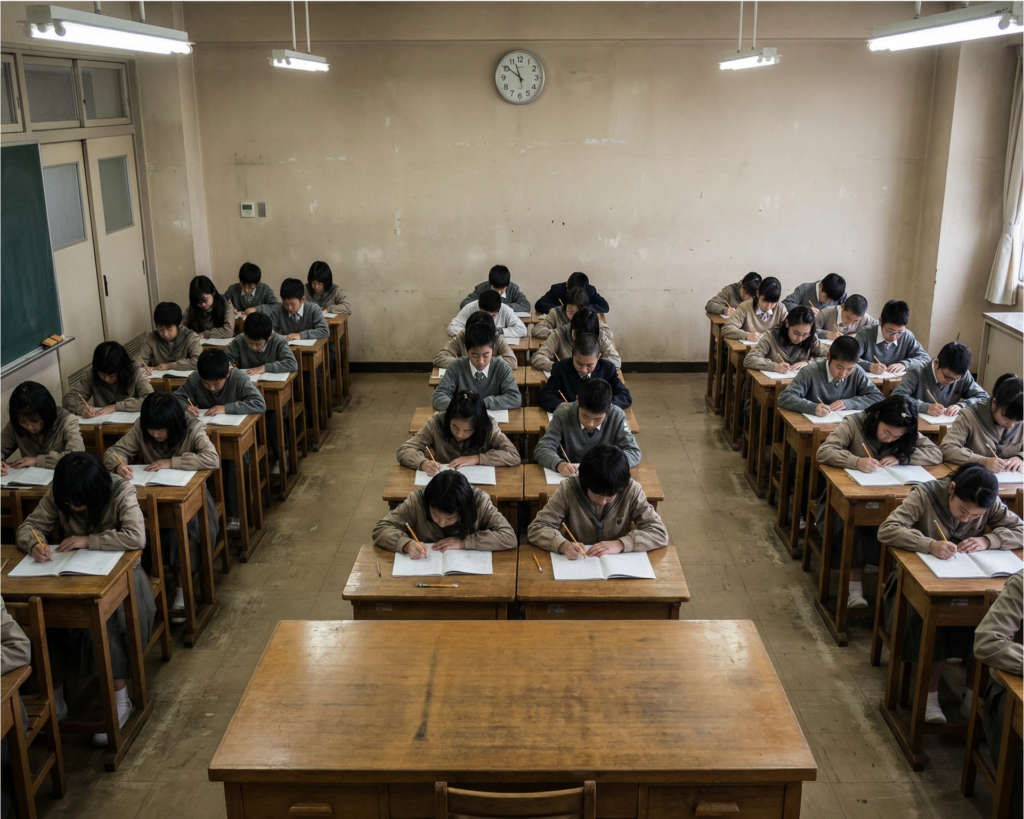
The Factory Floor of the Mind
Rows of desks, perfectly aligned. The chime of a bell dictating when to start, when to stop, when to move. A single authority figure at the front, dispensing information to be memorized and regurgitated. Does this sound like a place designed to foster creativity, innovation, and independent thought? Or does it sound more like a factory floor, designed for efficiency, compliance, and predictable output? For most of us, this was the reality of our education. We were taught to obey, not to think, and this was not by accident. It was by design.
The truth hurts, and the truth about our education system is a particularly bitter pill to swallow. We believe it’s a meritocratic engine of social mobility, but its historical roots reveal a darker purpose: to create a compliant, manageable populace that wouldn’t question authority. This isn’t a conspiracy theory; it’s a well-documented history that stretches back to 19th-century Prussia and was eagerly imported by American industrialists. As we explore on this site, facing the truth is the first step toward growth, and it’s time we faced the truth about why school felt so stifling.
Engineered for Obedience The Prussian Blueprint
 The modern school system’s DNA can be traced back to Prussia in the early 1800s. After a humiliating defeat by Napoleon’s forces, Prussian leaders concluded that their soldiers weren’t just outmaneuvered; they were insufficiently obedient. Their solution was the *Volksschule*, a compulsory public education system designed to instill unwavering loyalty and compliance to the state. As one historian noted, the goal was to ensure every individual believed, “in the core of his being, that the King was just, his decisions always right, and the need for obedience paramount.”
This model, focused on indoctrination rather than intellect, was imported to the United States by figures like Horace Mann in the mid-19th century and later scaled by industrialists like Rockefeller. Why? Because a factory-based economy requires a factory-based workforce: punctual, compliant, and willing to perform repetitive tasks without asking too many questions. A 2022 study from UC San Diego confirmed this, finding that education reforms historically followed periods of social unrest, designed to “indoctrinate people to accept the status quo.” The system wasn’t broken; it was, and is, working exactly as intended.
The Hidden Curriculum Still in Place Today
The explicit curriculum of math, science, and literature is only a small part of what we learn in school. The “hidden curriculum” is far more powerful, teaching us how to behave and think—or rather, how not to. This curriculum is built on several pillars of the original Prussian model:
- Time Fragmentation: By slicing the day into 45-minute, bell-driven blocks, the system prevents deep focus and teaches that all engagement is temporary and interruptible.
- Subject Compartmentalization: Knowledge is presented in isolated silos. History is separate from economics, which is separate from art. This prevents students from forming an integrated worldview, making them dependent on “experts” to connect the dots.
- Competitive Ranking: Constant grading and ranking create a zero-sum game, fostering anxiety and teaching that your worth is determined by external validation, not personal growth or genuine mastery.
This structure is reinforced by tools like standardized testing, which has little to do with measuring intelligence and everything to do with enforcing a uniform standard of knowledge. It rewards rote memorization and punishes divergent thinking, creating a generation of students who are good at taking tests but poor at solving novel, real-world problems. The current crisis in education isn’t just about funding or teacher shortages; it’s about a foundational design flaw.
Reclaiming Your Mind From the Factory
 The result of this system is a population conditioned for compliance. We learn to wait for instructions, to seek approval from authority figures, and to fear failure. The gap between the A-student who follows all the rules and the C-student who questions everything often closes or even inverts in the real world, where there is no syllabus and the problems are not multiple-choice. The skills that truly matter—critical thinking, creativity, risk-taking, and self-directed learning—are the very skills the system was designed to suppress.
Unlearning these lessons is the great challenge of adulthood. It requires a conscious effort to break the conditioning. It means embracing the discomfort of not knowing, pursuing curiosity without a curriculum, and learning to validate yourself. It’s about understanding that honesty, especially with yourself, is the only way to dismantle the false narratives we’ve been fed. It means recognizing that the factory bell is no longer ringing, and you are free to think for as long as you want about whatever you want.
The first step is acknowledging the truth of our own indoctrination. The system was not built for us, but we don’t have to be defined by it. The real education begins when you walk out of the classroom and start asking your own questions.