

The Difference Between Quiet Burnout and Quiet Quitting
You show up to work. You do your job. You collect your paycheck. On the surface, everything looks fine. But beneath the facade, something darker is happening — you’re slowly cracking, and nobody notices because you’re not making noise about it.
This is quiet burnout, and it’s becoming the defining workplace crisis of 2026. Unlike the remote work paradox that has made us lonelier than ever, quiet burnout operates silently. It doesn’t announce itself with resignation letters or dramatic exits. Instead, it whispers its presence through exhaustion, cynicism, and a slow erosion of your sense of purpose.
The uncomfortable truth is this: quiet burnout is far more dangerous than quiet quitting ever was. Those who are quietly cracking are 6.2 times more likely to slide into full clinical burnout, according to recent research. Yet most organizations remain blind to it, mistaking silent suffering for quiet competence.
What Exactly is Quiet Burnout?
Quiet burnout is fundamentally different from quiet quitting. When someone quietly quits, they’re making a conscious choice to do the bare minimum because they feel undervalued or disengaged. It’s a form of resistance, however passive.
Quiet burnout, by contrast, is involuntary. It’s what happens when you’ve been running on empty for so long that you can’t remember what it felt like to have energy. You’re not choosing to disengage — your mind and body are shutting down as a survival mechanism. You’re still trying. You’re still showing up. But you’re doing it from a place of complete depletion.
The distinction matters because it changes how we respond. You can’t motivate someone out of quiet burnout with better perks or team-building exercises. The problem runs deeper. It’s rooted in systemic toxicity, unrealistic expectations, and a culture that has normalized self-destruction in the name of productivity.
Recognizing the Signs of Quiet Burnout
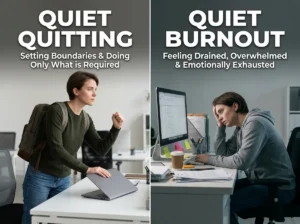 The insidious nature of quiet burnout is that it doesn’t always look like what we expect burnout to look like. You might not be crying at your desk or calling in sick every week. Instead, the symptoms are subtle — which is precisely why they’re so dangerous.
Emotional Exhaustion That Sleep Cannot Fix
You wake up tired. You go to bed tired. No amount of rest seems to restore your energy because the exhaustion isn’t just physical — it’s emotional and psychological. Your nervous system is in a constant state of activation, even when you’re not working. This is the hallmark of quiet burnout.
Detachment and Cynicism
You find yourself becoming increasingly cynical about your work, your colleagues, and your organization. Tasks that once felt meaningful now feel pointless. You’re going through the motions, but you’ve mentally checked out. This detachment is a protective mechanism — your psyche’s way of saying, “I can’t afford to care anymore.”
Declining Performance and Reduced Effectiveness
Paradoxically, quiet burnout often shows up as a decline in performance, even though you’re working just as hard (or harder). Your concentration wavers. Your creativity dries up. You make mistakes you wouldn’t normally make. This isn’t laziness — it’s cognitive overload.
Physical Symptoms You Can’t Explain
Headaches, digestive issues, muscle tension, and insomnia — quiet burnout manifests in the body. Your doctor might run tests and find nothing wrong, but your body is sending clear signals that something is unsustainable.
Why Toxic Workplace Culture is the Root Cause
Quiet burnout doesn’t emerge in a vacuum. It thrives in environments where silence is normalized and speaking up is discouraged. It flourishes in organizations where 59% of workers cite toxic workplace culture as the leading cause of poor mental health.
Toxic workplaces share common characteristics. There’s a pervasive culture of overwork, where staying late and sacrificing personal time are worn as badges of honor. There’s a lack of psychological safety, meaning employees feel they can’t voice concerns without risking retaliation or being labeled as “not a team player.” There’s also often a disconnect between stated values and actual practices — the organization talks about work-life balance while expecting constant availability.
In these environments, quiet burnout becomes the inevitable outcome. Workers can’t quit (for financial or practical reasons), so they internalize the stress. They blame themselves for struggling rather than questioning the system. They push harder, sacrifice more, and slowly deteriorate.
The Shift Toward Radical Transparency

Here’s where the narrative begins to shift. In 2026, we’re witnessing a fundamental change in how employees are responding to burnout culture. The silence is being replaced by something louder — radical transparency.
Rather than suffering in silence or quietly disengaging, forward-thinking employees and organizations are choosing to be honest. They’re having difficult conversations about workload, expectations, and mental health. They’re acknowledging that coping with emotional pain requires more than surface-level wellness programs — it requires systemic change.
Radical transparency means admitting when you’re struggling. It means leaders modeling vulnerability instead of projecting invincibility. It means creating spaces where employees can say, “I’m burned out,” without fear of consequences.
What You Can Do Right Now
If you recognize yourself in the signs of quiet burnout, know that you’re not alone — and you’re not weak for struggling. The system is designed to break you. But you do have agency in how you respond.
Name It
The first step is acknowledging what’s happening. Quiet burnout thrives in denial. Once you name it, you can address it.
Set Boundaries
Stop checking emails after hours. Stop taking on projects that aren’t your responsibility. Stop sacrificing your well-being for an organization that doesn’t reciprocate. Boundaries aren’t selfish — they’re survival.
Seek Support
Whether it’s therapy, coaching, or trusted friends, don’t carry this alone. Quiet burnout wants you to believe you’re the problem. You’re not. The problem is the system.
Consider Your Options
Sometimes the most radical act of self-care is leaving. If your organization is unwilling to change, you may need to find one that values your humanity as much as your productivity.
The Uncomfortable Truth

Quiet burnout is a symptom of a deeper cultural problem — one that values output over well-being, hustle over health, and profit over people. Until we’re willing to confront this truth, quiet burnout will continue to destroy the lives of millions of workers silently.
The good news? The conversation is finally shifting. More organizations are recognizing that facing the truth is the first step toward meaningful change. More employees are choosing radical transparency over silent suffering. And more people are asking themselves the hard question: Is this job worth my life?
That’s the wake-up call we all need to hear.