
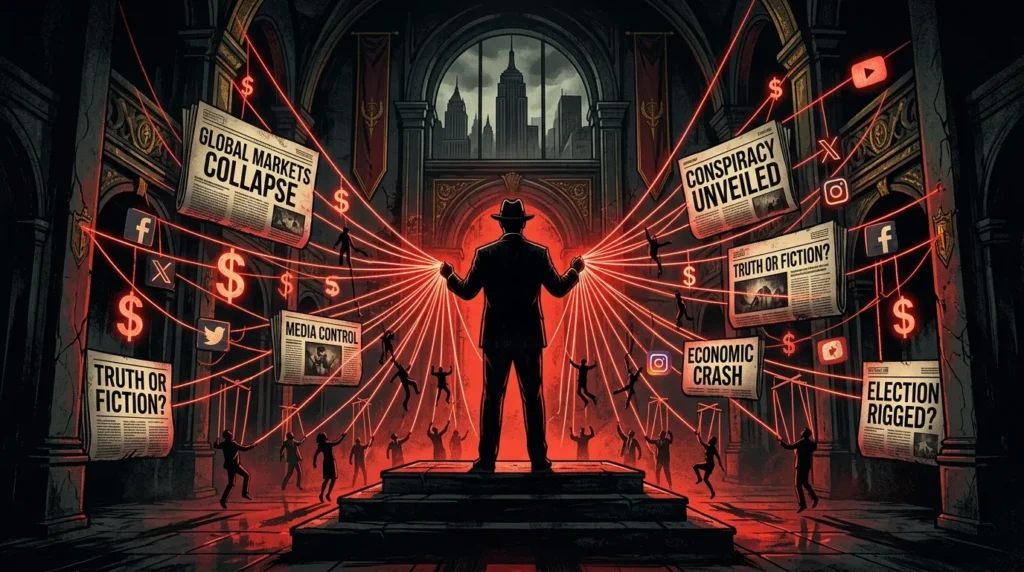
Every time a lie goes viral, someone gets paid.
Not by accident. Not as a side effect. By design.
The disinformation economy is not a conspiracy theory — it is a functioning, profit-generating machine. It has investors, infrastructure, incentive structures, and a near-bottomless supply of raw material: human emotion. Fear, anger, outrage, tribal loyalty — these are the currencies that make false information more valuable than the truth.
And here is the uncomfortable reality most people are not ready to face: you are not just the victim of this economy. In many cases, you are the product.
Understanding who profits when you believe a lie is the first step toward refusing to be used.
What Is the Disinformation Economy?
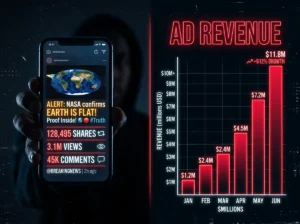
The disinformation economy refers to the network of financial, political, and social incentives that reward the creation and spread of false or misleading information. It is not a single industry — it is an ecosystem made up of advertisers, political operatives, content farms, social media platforms, and media personalities, all connected by a shared discovery: outrage is profitable.
This is not a new phenomenon. Yellow journalism in the 19th century sold newspapers through sensationalism. Propaganda has always served power. But what changed in the social media era is the scale, the speed, and the precision of the targeting. Algorithms can now identify exactly which emotional buttons to push for each individual user — and push them relentlessly, 24 hours a day.
The result is an information environment where false stories travel faster and farther than the truth. According to research cited by Signal AI’s 2026 Disinformation Impact Report, false content reaches up to 100,000 people while the truth rarely spreads past 1,000. That is not a glitch in the system. That is the system working exactly as designed.
The Business Model Behind the Lie
To understand who profits, you first need to understand the underlying business model. And it is shockingly simple: attention equals money.
The Advertising Machine
The dominant revenue model for most free online platforms — social media, news aggregators, content websites — is digital advertising. Advertisers pay for eyeballs. Platforms earn more money when users spend more time engaged. And users spend more time engaged when they are emotionally activated.
Here is where disinformation enters as the perfect product. A false, outrage-inducing headline about a politician, a celebrity, or a social issue generates far more clicks, shares, and comments than an accurate, nuanced story. The platform’s algorithm rewards this engagement by pushing the content to more users. More users see it. More ads are served. More money flows.
The advertiser whose product appears next to a fabricated story about election fraud or health misinformation often has no idea their brand is funding the lie. Their money passes through automated advertising systems — programmatic ad buying — and lands wherever engagement is highest. The content farm or fake news website on the receiving end cashes the check.
Content Farms and Clickbait Networks
Content farms are low-cost, high-volume operations that produce enormous quantities of emotionally manipulative content — not to inform, but to generate traffic. Many operate in countries where labor is cheap and oversight is minimal. A single content farm can generate hundreds of fake or misleading articles per day, each targeting specific emotional triggers within specific communities.
The more inflammatory the content, the more traffic it generates. The more traffic, the more ad revenue. Some of these operations earn tens of thousands of dollars per month from Google AdSense and similar networks simply by publishing fabricated stories designed to make people angry.
This is not journalism. It is emotional exploitation at industrial scale.
Political Disinformation: Power as the Currency
Not all disinformation is motivated by direct financial gain. For political actors — governments, campaigns, ideological movements — the currency is power. And disinformation is one of the most cost-effective tools ever developed for acquiring and maintaining it.
How Campaigns and Governments Use Manufactured Narratives

Political disinformation operates on a simple principle: if you cannot win the argument on facts, change what people believe the facts are. This is why disinformation campaigns target not just the opposition, but the information environment itself. The goal is not always to convince people of a specific lie. Often, the goal is confusion — to make people so uncertain about what is true that they disengage entirely, or retreat into their tribal bubble where their side’s narrative feels safe.
The World Economic Forum’s 2026 Global Risks Report identified misinformation and disinformation as one of the top short-term global risks, noting that it exacerbates every other major risk — from elections to economic crises — by eroding trust and magnifying instability.
This is not abstract. When disinformation floods an election cycle, voter behavior shifts based on fabricated realities. Policies get made in response to manufactured public opinion. And the people pulling the strings — the strategists, the dark money networks, the foreign state actors — get exactly the outcome they paid for.
The Influencer Industrial Complex
Between pure content farms and formal political operations sits a growing grey zone: the influencer industrial complex. These are social media personalities — some with millions of followers — who traffic in outrage, conspiracy, and misleading framing. Their motivation is a hybrid of financial gain and ideological alignment.
They earn revenue through platform monetization, merchandise, subscriptions, and sponsored content from organizations whose interests align with their narratives. They are rarely lying outright — they are skilled at selective framing, misleading context, and emotionally loaded language that technically stays within platform rules while doing the same damage as an outright lie.
This is one of the most effective and difficult-to-counter forms of modern disinformation, precisely because the people spreading it genuinely believe much of what they say — and their audiences trust them more than they trust traditional institutions.
The Platforms That Enable It All
It would be incomplete — and dishonest — to discuss the disinformation economy without naming the infrastructure that makes it possible: the social media platforms themselves.
Facebook, X (formerly Twitter), YouTube, and TikTok did not create disinformation, but they built the distribution network that made it catastrophically effective. Their algorithms are optimized for engagement, not accuracy. Emotional content — particularly anger and fear — drives more engagement than calm, factual reporting. This is not an opinion; it is a documented feature of how these systems work.
As covered in our piece on deepfakes and the collapse of trust, we have already entered an era where synthetic media makes it nearly impossible to distinguish real from fabricated. The platforms that carry this content profit from the chaos without bearing legal responsibility for it — shielded by legal frameworks like Section 230 in the United States that treat them as neutral conduits rather than publishers.
They earn billions in advertising revenue while the social cost — eroded democracy, public health crises driven by health misinformation, radicalization, and psychological harm — is distributed across society. The profit is privatized. The damage is collective.
What It Costs the Rest of Us
The disinformation economy does not just distort political reality. It has measurable, documented costs on public health, social cohesion, economic stability, and individual mental well-being.
Public Health and Medical Misinformation
Medical misinformation is one of the most dangerous products of the disinformation economy. False claims about vaccines, treatments, and health conditions spread through the same engagement-optimized channels as political lies. The financial incentive is identical — outrage and fear generate traffic — but the human cost is measured in lives.
Content creators who promote unproven or dangerous treatments earn revenue from the audiences they mislead. Supplement companies fund influencers who spread health misinformation to drive product sales. Patients who follow this advice may delay or refuse effective treatment. The Oncology Nursing Society reports that roughly 30% of cancer-related social media posts contain misinformation — and that 77% of those posts direct patients toward ineffective or harmful treatment avenues.
The Psychological Tax
Living inside the disinformation economy has a psychological cost that rarely gets named. When your information environment is saturated with manufactured outrage, emotionally manipulative framing, and unresolvable uncertainty about basic facts, the cognitive and emotional toll accumulates. Anxiety increases. Trust decreases. The sense that you can ever know what is actually true begins to erode.
This connects directly to the quiet burnout epidemic many are experiencing — the exhaustion is not just from work. It is from navigating a world where the information infrastructure is designed to destabilize you for profit.
How to Refuse to Be Used

Understanding the disinformation economy does not mean retreating into cynicism or disengaging from information entirely. It means becoming a more deliberate, critical consumer of information — and recognizing the moments when your emotions are being used as a business asset.
Follow the Money
When you encounter content that makes you feel intensely angry, afraid, or certain — pause. Ask: who benefits if I share this? Who profits if this narrative dominates? Is there a financial or political incentive behind the framing? These questions do not make you paranoid. They make you harder to exploit.
Verify Before You Amplify
Sharing unverified content, even with good intentions, makes you a free distributor for the disinformation economy. Use fact-checking tools, cross-reference claims across multiple credible sources, and apply particular scrutiny to content that confirms exactly what you already believed. The lies we tell ourselves are often the ones we never question — and that makes them the most dangerous ones to believe.
Demand Platform Accountability
Individual vigilance matters, but the scale of this problem requires structural change. Support regulatory frameworks that hold platforms accountable for algorithmic amplification of harmful content. Support funding for public media and independent journalism. Recognize that an informed society is not something the market will deliver on its own — it is a public good that requires public investment.
The Truth They Don’t Want You to See
The most unsettling truth about the disinformation economy is not that bad actors are lying to you. It is that the entire system — the platforms, the advertisers, the algorithms, the content farms — functions more efficiently when you cannot tell what is real.
Confusion is profitable. Division is profitable. Outrage is profitable. Truth, by contrast, is slow, complex, and often emotionally unrewarding. It does not go viral. It does not generate ad revenue. It rarely trends.
But it is the only thing that has ever actually set anyone free.
If you are serious about cutting through the noise and confronting systems designed to keep you manipulated, start by reading about how we were conditioned not to think critically — because the disinformation economy did not build its audience from nothing. It built it from people who were never taught to question what they were told.
The lie has a business model. The question is whether you are still on its payroll.