

We live in an age when reaching someone takes seconds. A smartphone can connect us with friends across the country, relatives overseas, former classmates, coworkers, and millions of strangers. Video calls allow families to see one another despite living thousands of miles apart, while social media provides an endless stream of updates about the people around us. On the surface, modern technology appears to have solved one of humanity’s oldest problems: the difficulty of staying connected.
Yet something does not add up. A person can spend an entire evening responding to messages, watching videos, scrolling through photographs, and checking notifications, only to put the phone down and realize that nobody has asked how they are really doing. The screen may be full of activity, but the room can still feel painfully quiet.
This contradiction sits at the heart of the loneliness epidemic in America. Digital communication has made it easier to contact people, but contact alone does not necessarily create closeness, trust, belonging, or emotional support. We can know what dozens of people ate for dinner without knowing whether a single one of them is struggling. We can celebrate hundreds of birthdays online and still lack someone to call when life becomes difficult.
The issue deserves serious attention because loneliness is not simply a passing mood or a personal weakness. The U.S. Centers for Disease Control and Prevention (CDC) identifies loneliness and social isolation as important public health concerns associated with mental and physical health risks. Its overview of the health effects of loneliness and social isolation explains why meaningful social relationships matter throughout life.
The uncomfortable truth is that modern America has created extraordinary opportunities for communication without guaranteeing the human connection people need. Technology is part of the story, but so are work demands, financial pressure, changing neighborhoods, family responsibilities, social expectations, and the growing difficulty of making time for relationships.
Understanding this problem requires looking beyond screen time. We must examine how people live, what they value, how communities function, and why so many individuals feel disconnected even when they appear socially active.
What Does the Loneliness Epidemic in America Really Mean?
Loneliness and social isolation are related, but they are not the same thing. Social isolation describes a lack of social relationships, regular contact, or a support network. Loneliness describes the subjective feeling that our relationships do not provide the closeness or connection we want.
This distinction is important because a person can live alone and feel perfectly content, while someone surrounded by family members, coworkers, or friends can feel profoundly lonely. The number of people in a room does not determine whether someone feels understood.
The CDC explains that loneliness often reflects a gap between the connections people have and the connections they want. This means the experience can affect people across age groups, income levels, relationship statuses, and geographic locations.
Consider a parent who spends every day caring for children but has little adult conversation beyond practical household matters. Consider an employee who attends meetings throughout the day but feels unable to speak honestly with colleagues. A college student might live in a crowded residence hall and still believe that nobody knows their real personality. An older adult might have a loving family but rarely see anyone because transportation is difficult.
These situations look different, but each can involve a shortage of meaningful connection.
It is also important to avoid suggesting that every American is becoming lonelier every year. Social experiences vary considerably, and some people maintain strong support systems. The CDC’s community and connection data provides a useful way to examine loneliness and social support across U.S. populations rather than assuming everyone shares the same experience.
The phrase “loneliness epidemic” describes the scale and significance of the concern, not a claim that every person is isolated or that technology alone caused the problem. A responsible discussion recognizes the complexity of modern relationships while taking the consequences of disconnection seriously.
How Social Media Changed the Meaning of Friendship
Social media promised to bring people closer together. In many situations, it has delivered on that promise. People can maintain long-distance friendships, find support during difficult experiences, reconnect with family members, and discover communities that might not exist in their immediate surroundings.
The problem begins when online interaction becomes a substitute for every other form of connection.
A social media account can display hundreds or thousands of followers, but those numbers do not reveal how many people would offer meaningful support during a crisis. Likes and comments can create a brief sense of recognition, yet they do not necessarily develop into trust. A message that says “thinking of you” may be thoughtful, but a long conversation in which someone listens carefully can provide a different level of emotional reassurance.
Social platforms also encourage people to present carefully selected versions of their lives. Vacation photographs, professional achievements, attractive homes, celebrations, and romantic milestones create a continuous display of positive moments. Ordinary disappointments, awkward conversations, financial worries, and quiet evenings receive much less attention.
Comparing our private struggles with other people’s public highlights can make normal life feel inadequate. Someone who is already lonely may see photographs of a large gathering and conclude that everyone else has a richer social life. A person facing career uncertainty may interpret a former classmate’s promotion as evidence that they are falling behind.
The comparison is often unfair because social media rarely presents the complete picture. A photograph can show a happy gathering without revealing the tensions behind it. An impressive online personality may experience insecurity away from the camera. A large following does not guarantee a dependable support system.
The answer is not necessarily to abandon social media. For people separated from family, living with disabilities, or searching for others who share a specific interest, online communities can be valuable. The more useful question is whether digital interaction supports real relationships or quietly replaces them.
If checking notifications becomes more important than speaking with someone sitting nearby, the technology may be taking up space that meaningful connection needs.
Why Constant Notifications Can Leave Us Emotionally Empty
Smartphones have changed not only how frequently we communicate but also how we experience the present moment.
A conversation can be interrupted by a notification. A family meal can become a series of separate scrolling sessions. Friends can sit together while each person concentrates on a different screen. Even when nobody intends to be rude, divided attention can make interactions feel less satisfying.
Meaningful relationships require more than physical proximity. They depend on attention, curiosity, responsiveness, and a willingness to engage with another person’s experience. When attention repeatedly shifts away from a conversation, people may feel that they are competing with a device for recognition.
This does not mean every notification damages a relationship or that using a phone during a gathering automatically creates loneliness. Context matters. A parent might need to remain available for an emergency, and a person may use a phone to communicate with someone who cannot attend in person.
The concern is habitual distraction that prevents people from being fully present.
Imagine telling a friend about a difficult week while they repeatedly look down at their phone. They might hear every word, but their behavior can leave you wondering whether your experience matters. Compare that with a conversation in which the same friend puts the device away, asks questions, remembers details, and responds with empathy.
The difference is not the length of the conversation. It is the quality of attention.
A practical starting point is to create small periods when devices are not the center of an interaction. Families can put phones aside during dinner, friends can agree to take a walk without constantly checking notifications, and couples can establish time to talk without television or social media competing for attention.
These changes are simple, but they communicate an important message: the person in front of us deserves more than whatever attention remains after everything else has been checked.
 The Hidden Cost of Modern American Work Culture
Work can provide purpose, financial stability, professional identity, and opportunities to build friendships. However, demanding work schedules can also leave people with very little time or energy for their personal relationships.
Many Americans balance employment with commuting, childcare, household responsibilities, education, and financial obligations. When the working day ends, the remaining hours may be consumed by errands, cooking, cleaning, and preparing for the next morning. Social activities can begin to feel like additional responsibilities rather than sources of enjoyment.
Remote work adds another layer of complexity. Working from home can reduce commuting time and offer valuable flexibility, but some employees lose the casual conversations that once occurred in hallways, break rooms, and shared offices. Others may spend entire days communicating through work platforms without developing friendships with colleagues.
Neither remote work nor office work automatically produces loneliness. A remote employee with strong friendships and a supportive household may feel connected, while someone working in a busy office can feel entirely alone. The central issue is whether a person’s daily routine provides opportunities for meaningful relationships.
Economic pressure can make the situation worse. When housing costs, debt payments, transportation, and basic expenses consume much of a household’s income, people may have fewer opportunities to travel, participate in clubs, attend events, or invite others into their homes. Even inexpensive activities can become difficult when work schedules are unpredictable or caregiving responsibilities leave little free time.
It is misleading to treat loneliness exclusively as an individual failure to socialize. Sometimes the problem is a lack of affordable opportunities, accessible transportation, predictable free time, or safe public spaces where people can meet.
Employers can help by encouraging reasonable boundaries, creating opportunities for informal interaction, and recognizing that employees have lives outside work. Communities can contribute by providing accessible recreation programs, libraries, public gathering places, and events that do not require significant spending.
People need personal initiative, but they also need environments in which maintaining relationships is realistically possible.
Why Young Adults Can Feel Lonely Despite Being Online All Day
Loneliness is not limited to older people living alone. Young adults can experience disconnection during periods when friendships, careers, relationships, and personal identities are changing rapidly.
College students may move away from familiar communities and discover that making friends as an adult requires more effort than expected. Recent graduates can lose the daily contact that came from school while adjusting to demanding jobs, new cities, or uncertain career prospects. Others may compare their lives with carefully curated images of people who appear more successful, attractive, socially active, or financially secure.
Online communication can help young adults find communities that share their interests and experiences. It can also create pressure to remain constantly available, respond quickly, and maintain a public identity that appears interesting. When personal value becomes tied to attention and approval, ordinary periods of quiet can feel like rejection.
There is another challenge: friendship often develops through repeated, low-pressure interaction. People become familiar with one another by attending the same class, joining the same club, working together, or meeting regularly in a neighborhood. Digital communication can sustain those relationships, but a constant stream of new content may distract from the patience required to build them.
Young adults may also hesitate to admit that they are lonely. They may assume that everyone else has a close group of friends or believe that struggling socially means they are doing adulthood incorrectly.
In reality, many life transitions temporarily disrupt existing support systems. Moving, changing jobs, ending a relationship, or becoming a parent can all require people to rebuild their social lives.
The solution is not to force instant intimacy. It is to create recurring opportunities for familiarity to develop. A weekly recreational sports league, a volunteer commitment, a study group, or a regular visit to a community event can provide a foundation for relationships that grow over time.
Older Americans and the Risk of Social Disconnection
Older adults may face particular challenges when circumstances reduce their opportunities to interact with others. Retirement can remove daily workplace relationships, while the loss of a spouse or close friends can change a person’s social world dramatically. Health problems, hearing difficulties, reduced mobility, and limited transportation can make familiar activities harder to maintain.
Living alone does not automatically mean someone is lonely, and older adults should not be treated as a uniform group. Many maintain active social lives, develop new friendships, volunteer, participate in community organizations, and enjoy independent living. Nevertheless, changes in health, mobility, and family circumstances can make maintaining those relationships more difficult.
Geography can also matter. In some suburban and rural communities, reaching a library, recreation center, or friend’s home may require a car. An older person who no longer drives can lose access to routine social activities even when supportive people live nearby.
Families can help by asking specific questions instead of assuming that occasional phone calls are enough. Does the person have a reliable way to get to appointments? Are there activities they would enjoy if transportation were available? Have hearing or mobility difficulties made conversations or gatherings uncomfortable? Would a regular visit or shared activity make a difference?
Community organizations can support older residents through meal programs, transportation assistance, volunteer networks, exercise classes, and accessible gathering places.
Technology can be especially useful when physical distance is unavoidable. Video calls and group chats can help relatives stay involved, but they should complement in-person interaction and practical assistance whenever possible.
The goal is not to eliminate solitude. Many older adults value quiet and independence. It is to make sure that people have opportunities to participate in relationships and communities when they want or need them.
How Loneliness Can Affect Mental and Physical Health
Loneliness is often dismissed as an uncomfortable emotion that people should overcome by staying busy. That response overlooks the relationship between social connection and overall health.
The CDC identifies loneliness and social isolation as factors associated with increased risks of depression, anxiety, heart disease, stroke, type 2 diabetes, and dementia, among other health concerns. These relationships are complex, and an association does not mean that loneliness directly causes every condition in every individual.
Social connection can support health in several ways. Trusted relationships provide emotional reassurance during stressful periods, practical assistance when life becomes difficult, and encouragement to maintain routines that support well-being. Friends and family may notice when someone is struggling and help them find appropriate support.
By contrast, prolonged disconnection can leave a person feeling that they must handle every challenge alone. Stress may become harder to manage when there is nobody to discuss problems with, and a lack of social support can make it more difficult to maintain healthy habits.
Loneliness can also become self-reinforcing. Someone who feels rejected may begin avoiding invitations because they expect to be unwelcome. Reduced interaction then creates fewer opportunities for positive experiences, potentially strengthening the belief that nobody cares.
This pattern is not inevitable, and it should not be interpreted as evidence that lonely people are responsible for their circumstances. Depression, anxiety, grief, disability, discrimination, financial hardship, and unsafe relationships can all complicate social connection.
Anyone experiencing persistent loneliness alongside significant distress may benefit from speaking with a qualified mental health professional or healthcare provider. Professional support can help people understand the factors contributing to their feelings and identify practical next steps.
For additional background, the U.S. Department of Health and Human Services offers its Surgeon General’s advisory on social connection. The resource explains why relationships matter for individual health and community well-being and provides ideas for strengthening social connection.
 The Difference Between Being Alone and Feeling Lonely
One reason conversations about loneliness can become confusing is that society sometimes treats being alone and being lonely as interchangeable experiences.
They are not.
Solitude can be restorative. Time alone allows people to reflect, pursue hobbies, recover from busy schedules, and enjoy their own company. A person who chooses solitude and feels satisfied with their relationships may have a healthy social life, even if they spend many hours alone.
Loneliness, by contrast, involves a mismatch between the connection someone wants and the connection they experience. It may occur in solitude, but it can also happen at a crowded party, during a family gathering, or in a long-term relationship.
This distinction matters because the solution is not simply to fill every empty hour with social activity. A person who is exhausted by constant obligations may need rest, while someone who feels emotionally unseen may need more meaningful conversations rather than more invitations.
The better question is not, “How many people did I see today?” It is, “Did I experience the kind of connection that matters to me?”
For some people, that connection comes from a close friendship. For others, it involves family, a partner, a faith community, a volunteer group, or a shared interest. Different people need different amounts and forms of interaction.
Recognizing these differences makes it easier to address loneliness without shaming people for enjoying solitude or assuming that everyone should have the same social life.
Why Building Friendships as an Adult Can Feel So Difficult
During childhood and adolescence, schools and organized activities create repeated opportunities to meet the same people. Friendships can emerge from proximity, shared experiences, and time spent together without much planning.
Adulthood often removes that structure. People move, change jobs, raise families, care for relatives, and develop responsibilities that compete for their attention. Even when two people like each other, coordinating schedules can become difficult.
Adult friendship also requires vulnerability. Initiating a conversation or inviting someone to spend time together involves the possibility of rejection. After a painful breakup, a difficult friendship, or years of social disappointment, people may hesitate to take that risk.
Some adults interpret a quiet social calendar as evidence that they are unlikeable. Yet a lack of opportunity is not the same thing as a lack of personal value. Many people are simply caught in routines that provide few chances to form new relationships.
One effective strategy is to focus on repeated participation rather than immediate friendship. Join an activity that meets regularly, such as a walking group, community class, book club, recreational league, or volunteer organization. Returning to the same place makes it easier to recognize familiar faces and move beyond superficial introductions.
It also helps to make invitations specific and manageable. Instead of saying, “We should hang out sometime,” suggest coffee on Saturday morning or a short walk after work. A clear invitation gives the other person something concrete to respond to.
Friendship rarely develops through a single perfect conversation. It usually grows through small interactions, reliability, shared experiences, and the gradual discovery that two people enjoy one another’s company.
How to Reduce Loneliness Without Making Life More Complicated
Addressing loneliness does not require becoming extremely outgoing, attending events every night, or transforming your personality. Sustainable change often begins with small actions that fit into an existing routine.
Prioritize Meaningful Conversations
Rather than measuring social success by the number of messages you exchange, pay attention to the quality of your conversations. Ask a friend how they are coping with a particular challenge, listen without immediately offering solutions, and share something honest about your own life.
Meaningful conversations do not have to be dramatic. Talking about everyday experiences, personal interests, worries, and hopes can gradually strengthen trust.
If someone comes to mind while you are reading this article, consider contacting them with a genuine question. A simple message can reopen a conversation, especially when both people have been busy.
Create Regular Opportunities to See People
Spontaneous social plans can be difficult to maintain when everyone has competing obligations. Regular activities reduce the need to organize every interaction from scratch.
You might arrange a monthly dinner with friends, attend a weekly fitness class, volunteer twice a month, or visit a local community group. Consistency creates familiarity, and familiarity can make future conversations easier.
Choose activities that interest you rather than attending events simply because they appear popular. Shared interests provide natural subjects for conversation and make participation more enjoyable.
Use Technology to Strengthen Relationships
Digital tools are not the enemy of connection. They become more useful when they help people arrange meetings, maintain relationships across distance, and communicate with genuine attention.
Send a personal message rather than relying entirely on public posts. Schedule a video call with a relative who lives far away. Use a group chat to arrange an actual gathering instead of allowing it to become an endless stream of messages that never leads anywhere.
When possible, combine online communication with other forms of interaction. A text can begin a conversation, a call can deepen it, and a shared activity can help the relationship grow.
Learn to Reach Out Without Waiting for the Perfect Moment
People often delay contacting others because they do not want to appear needy, interrupt someone, or admit that they have been lonely. Unfortunately, waiting for someone else to notice can leave both parties assuming that the other person is too busy.
Reaching out does not require a dramatic confession. You can tell a friend that you miss talking with them, ask a colleague whether they would like to have lunch, or invite a neighbor to join you for a walk.
Not every invitation will be accepted. People have their own responsibilities, and an unanswered message does not automatically indicate rejection. If someone repeatedly shows no interest, it is reasonable to direct your energy toward relationships that are more reciprocal.
The goal is to create opportunities for connection while respecting your own time and emotional needs.
Find Ways to Contribute to Your Community
Connection is not only about receiving attention. Helping other people can create a sense of purpose and provide opportunities to interact with people who share your values.
Community volunteering, neighborhood projects, mentoring, library programs, food assistance organizations, and local recreation groups can bring people together around a common goal.
These activities can be especially useful for adults who find unstructured socializing uncomfortable. When people work together on something practical, conversation can develop naturally rather than feeling like an interview.
Contribution should not become another obligation that exhausts you. Choose a commitment that fits your schedule and abilities, and remember that small acts of participation can matter.
Seek Professional Support When Needed
Sometimes loneliness is connected to grief, depression, anxiety, trauma, relationship difficulties, or other challenges that make social interaction feel overwhelming. In those situations, practical social steps may help, but they might not be enough on their own.
A licensed mental health professional can help explore patterns that make relationships difficult and develop strategies for building confidence, managing distress, or addressing underlying concerns. Healthcare providers can also help assess persistent emotional symptoms and discuss appropriate treatment options.
Seeking support is not an admission of failure. It is a reasonable response when a problem affects your well-being and becomes difficult to manage alone.
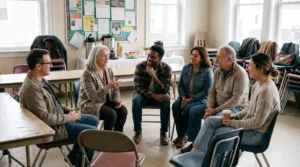 What American Communities Can Do to Rebuild Human Connection
Although individuals can take steps to improve their social lives, the loneliness epidemic cannot be addressed entirely through personal advice. Communities shape the opportunities people have to meet, participate, and develop lasting relationships.
A neighborhood with accessible sidewalks, public parks, libraries, recreation centers, and welcoming community spaces provides more opportunities for casual interaction than an environment in which every trip requires a car and every activity requires spending money.
Local governments and organizations can help by supporting affordable programs, accessible transportation, community events, and spaces where people from different backgrounds can participate. Schools, libraries, workplaces, and community centers can create recurring activities that encourage people to meet beyond their usual social circles.
Employers also have a role. Reasonable schedules, supportive workplace cultures, and opportunities for employees to interact can help people maintain relationships outside their immediate household. Remote teams can benefit from intentional social opportunities, provided that participation does not become another mandatory meeting.
Technology companies can consider how their products influence attention and interaction. Digital services can help users maintain relationships, but design choices that reward endless engagement may make it harder for people to disconnect when they want to spend time with others.
Families and friends can contribute by including people who might otherwise be overlooked. An invitation to dinner, a ride to a community event, or a regular check-in can make participation easier for someone facing mobility challenges, financial limitations, or a recent life change.
The HHS social connection framework emphasizes action by individuals, communities, institutions, and governments. This broader perspective is important because meaningful connection depends partly on whether society makes room for people to build and maintain relationships.
A culture that values productivity above everything else may leave little time for friendship. A community that treats public gathering spaces as unnecessary may unintentionally reduce everyday opportunities to connect. Addressing these conditions requires more than telling lonely people to try harder.
The Uncomfortable Truth About Our Always-Connected World
Modern technology has made communication easier, but it has not removed the human need to feel understood. We can reach people instantly without making time for them, exchange messages without developing trust, and watch other people’s lives without participating meaningfully in our own communities.
The uncomfortable truth is that convenience and connection are not interchangeable. A quick reaction can acknowledge a post, but it cannot always replace a conversation. A large online audience can provide visibility without providing emotional support. A busy schedule can make a person appear socially active while leaving little room for relationships that matter.
Another uncomfortable truth is that meaningful connection requires effort. Someone has to initiate the conversation, listen when the answer is difficult, make time for shared experiences, and remain present when the novelty of a relationship fades.
That effort cannot guarantee that every friendship will last or that every person will respond positively. Human relationships are complicated, and loneliness can arise for reasons beyond an individual’s control. Nevertheless, consistent attention and reciprocal care give relationships opportunities to grow.
We should also stop treating loneliness as something embarrassing that people must hide. Admitting that we want closer friendships is not a weakness. It is an honest recognition of a basic human need.
Instead of asking whether we have enough followers, contacts, or messages, we can ask whether we have people with whom we can speak honestly. Instead of measuring every day by productivity, we can consider whether we made room for the relationships that give life meaning.
And instead of assuming that someone who seems cheerful is doing fine, we can make space for conversations that go beyond appearances.
Conclusion: Reconnecting in a World That Never Stops Talking
The loneliness epidemic in America reveals a contradiction at the center of modern life. We have more ways to communicate than previous generations could have imagined, yet many people still struggle to find the kind of connection that makes them feel valued, understood, and supported.
Technology contributes to this challenge when it encourages distraction, comparison, and shallow interaction, but it can also help people maintain relationships and discover supportive communities. Work demands, financial pressure, transportation barriers, health challenges, major life transitions, and changing community structures also influence whether people can build meaningful social lives.
There is no single solution that works for everyone. Some people need to reconnect with old friends, while others need opportunities to meet new people. Some benefit from reducing distracting screen habits, while others need professional support or practical help overcoming barriers to participation.
What matters is recognizing that human connection deserves a place in our priorities. A message can open the door, a conversation can build trust, and repeated acts of attention can turn an acquaintance into a friend.
America does not need to abandon technology to become more connected. It needs to use technology more intentionally, build communities that welcome participation, and recognize that relationships are not luxuries to pursue only after every other responsibility has been completed.
The next time you find yourself scrolling through a crowded digital world while feeling strangely alone, consider putting the phone down for a moment. Call someone you trust, invite a friend for coffee, attend a local event, or simply ask another person how they are doing and listen to the answer.
The goal is not to be surrounded by people every minute of the day. It is to know that genuine connection is available when we need it, that our presence matters to others, and that we have opportunities to build relationships that extend beyond a screen.
In an always-connected world, perhaps the most meaningful change is not finding more people to contact. It is making more room for the people with whom we can truly connect.